

A New Threat to the Spotted Owl: Congress.

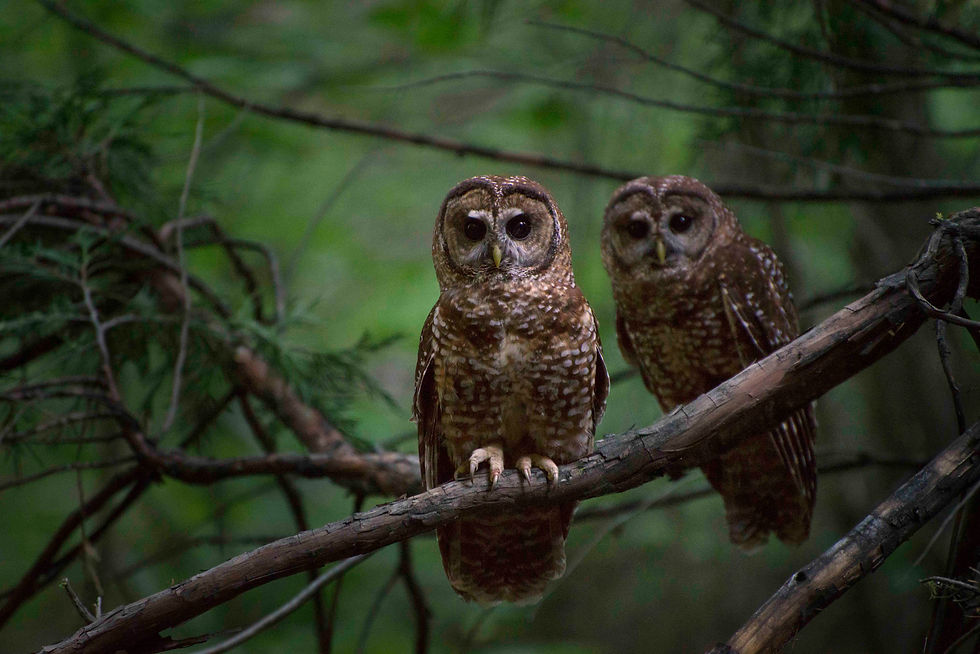
The spotted owl faces one of its greatest threats: Congress. Last fall, the U.S. Fish and Wildlife Service released its Barred Owl Management Strategy, a cohesive plan to deal with the threat from non-native barred owls. The Strategy targeted barred owl removal in areas that would have the greatest beneficial effect on northern spotted owls and California spotted owls. Now, two Congressional Review Act resolutions have been introduced that would invalidate the Strategy,
Here, animal rights groups find themselves in a strange partnership with MAGA Republicans. Republican support for the resolutions does not stem from concerns about animal welfare or concerns about the role of lethal removal in wildlife management (topics that groups like EPIC share). Instead, Republican opposition has largely been tied to an artificial price tag created by animal rights groups.
Animal Wellness Action, one of the primary antagonists of the Strategy, claims that the program would cost an eye-watering $1.35 billion. But this is an exaggerated number of their own creation. Using a single grant awarded by the National Fish and Wildlife Foundation to the Hoopa Valley Tribe, Animal Wellness Action “extrapolated” the figure to absurd proportions.
How much is removal actually expected to cost? Based on previous removal experiments, full implementation of the strategy is anticipated to cost between $4.5-12 million per year, with costs of implementation expected to decrease over time as the population of barred owls is reduced. Thus, even in the worst-case scenario, animal rights groups are off by about a billion dollars. These costs are to be borne by the many federal agencies, state and tribal governments, and private actors who will implement the strategy.
Protecting the northern spotted owl requires hard choices about the barred owl. Thankfully, conservation groups from across the country are stepping up to oppose the Congressional Review Act resolution.
Why Barred Owl Removal?
Barred owls are not native to the West Coast of North America (Livezey 2009a). Settlement of the Great Plains facilitated the expansion of their range by creating more forested conditions (Livezey 2009b). As West Coast ecosystems did not co-evolve with the barred owl, this recent invasion has caused considerable disruption, best demonstrated by the northern spotted owl. The barred owl is larger and more aggressive than the northern spotted owl, and where their ranges overlap, the barred owl outcompetes the northern spotted owl, driving the species towards extinction (Franklin et al. 2021). While impacts to northern spotted owls are the most well-documented, other species, such as western screech owls, are also being impacted by barred owls (Acker 2012), and scientists worry that barred owl invasion can have destabilizing effects on entire ecosystems (Holm et al. 2016; Baumbusch 2023). Thankfully, research has shown that barred owl removal is effective, feasible, and humane.
Where employed, barred owl removal has effectively stemmed the decline of northern spotted owls. For example, in the largest removal experiment to date, removal virtually stopped the decline of spotted owl in areas with removals (0.2% decline per year) compared to steep declines in areas without removals (12.1% decline per year) (Wiens et al. 2021). With barred owl removal, the northern spotted owl is expected to persist across large areas of its range and offers the possibility of species recovery; without barred owl removal, extinction of the northern spotted owl is virtually assured and is likely to occur within the next 50 years (Yackulic et al. 2019).
Barred owl removal is financially feasible and technically achievable. Implementation of the Strategy is expected to cost between $4.5-12m/year, with costs likely to decrease in the future as initial removal efforts will be more costly as the initial population of barred owls to be removed is higher (Dumbacher and Franklin 2024). Past removal experiments have likewise demonstrated that implementation of the Strategy is feasible and that removal is likely to produce significant positive outcomes for native species (Wiens et al. 2021).
Removal is also humane and with substantial precedent. Removal experiments have shown that lethal removal of barred owls generally occurs with a single shotgun shot (97.4% single-shot kills) and that, through over 2,485 barred owls removed, not a single non-intended species was accidentally taken (Wiens et al. 2021). While some individuals object to active intervention measures, such as removal of competing non-native species, issuance of Migratory Bird Treaty Act permits to remove non-native species is also allowed and has been successfully utilized elsewhere (Oretega et al. 2025).


Comments