

ACTION ALERT: Trump Seeks to Open Roadless Forests to Logging
Updated: Aug 25
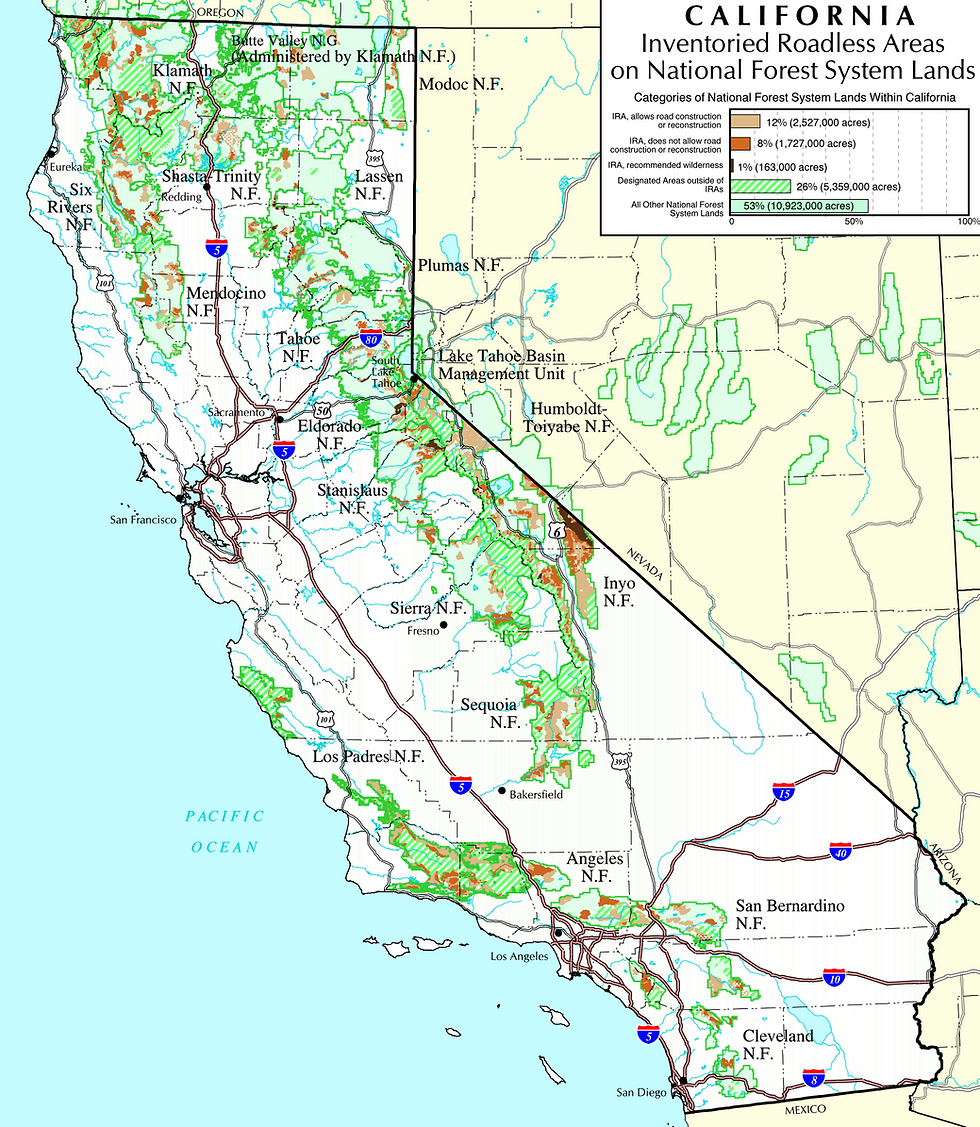
The Trump Administration is moving forward with its plans to dismantle the 2001 Roadless Rule. The Roadless Rule offers protection for roughly 45 million acres of public lands, called “inventoried roadless areas,” against extractive industries, road construction, and other developments. Last week, the Forest Service released the Draft Environmental Impact Statement for this proposed rescission. The Trump Administration claims that the rescission is necessary to address wildfire; however, upon examination, it is clear that this is being done to log our public land and to stop future Wilderness designations.
The Trump Administration’s announcement claims that the rule needs to be removed to allow for better fire management. We are skeptical. First, fire risk reduction work in roadless areas is already allowed under the Roadless Rule, and over two million acres of fire risk reduction work has been completed in roadless areas since the 2001 rule. Second, roads are an important source of fire ignitions. In California, 95% of all wildfires are started by humans. Roads are intimately related to these fires—from a carelessly tossed cigarette out of a car window to flat tires and dragging chains shooting sparks into dry grass. As a math equation, it looks like this: more roads = more fire starts.
Roads can be useful in putting out fires. But roadless areas are generally not a high priority for fire risk reduction work. By their nature, roadless forests are generally further from human habitations (although some exist in the “Wildland Urban Interface”) and therefore are a lesser priority for fire risk reduction treatments. Given the backlog of “good fire” on the ground, we need to prioritize fire risk reduction work around communities. Projects in the backcountry won’t have much benefit when it comes to human safety. And as California has learned, we need fire—and roadless areas are well-primed to burn. These forests generally contain older, fire-adapted trees as roadless areas are less likely to have been logged previously. The thick bark of older trees makes these trees more resilient to the effects of fire, and because these areas are less of a priority for fire suppression, roadless forests in California have burned more regularly.
So why target roadless areas? The Forest Service’s road network is largely to facilitate logging, and without roads, many of these roadless areas are unentered stands of old-growth. Early in his second term, President Trump ordered all departments of the government to do everything they could to increase logging. By opening these areas to logging, the Trump Administration could boost timber production by targeting big, old trees for logging. It makes sense then that the Roadless Rule rescission is being celebrated by the Timber Industry.
The Forest Service currently maintains over 370,000 miles of roads, enough to wrap around the world 15 times. The Forest Service currently struggles with a backlog of deferred maintenance of its existing road network and is supposed to take steps to determine the minimum necessary road network to complete its work. In northern California, 61% of our waters are “impaired” because of sediment pollution. Poorly maintained forest roads are a chief culprit of that pollution. We need fewer roads, not more of them.
To comment before the deadline on September 21st at 9 PM PT, visit https://www.regulations.gov/commenton/FS-2025-0001-223869
Our friends and allies at FUSEE have put together an easy form for you to simplify and personalize your comments.
Resources and Studies:
Older Posts:
THE ECO NEWS REPORT: Potholes in the Forest Service Roadless Rule July 5th, 2025
Roadless Rule Rescission June 24, 2025
ACTION ALERT: Roadless Rule Rescission Posted for Public Comment August 29, 2025


Comments