

Timber Harvest Plan (THP) Public Comment Resources
Disclaimer: The following is not legal advice.
What is a THP?
-
Under California law, forestland owners must submit a timber harvest plan (THP) to cut or remove trees that are to be processed into logs, lumber, or other wood products for sale, barter, exchange, or trade.
-
Only applies to lands other than those owned by the federal government, designated experimental forest land, or tribal lands
-
-
A THP is the functional equivalent of a California Environmental Quality Act (CEQA) Environmental Impact Report (EIR). The THP serves as the environmental analysis for the project.
-
CAL FIRE reviews and approves or denies THPs according to the Forest Practice Act, which is implemented by the Forest Practice Rules. The Board of Forestry makes these rules.
-
It usually takes 6 to 18 months to complete and process a THP
-
Each THP is valid for 3 years, but may be extended by 2 additional years.
-
Related Documents and Permits
.png)
Other permits that are often needed in forest management
- Lake and Streambed Alteration Agreements (1600 Agreements)
Key Terms
_edited_edited.png)
Phrases to Know
-
Notice of intent — after THP is prepared, it’s posted on the public road nearest to the plan area; CAL FIRE distributes it to all neighbors within 300 ft of the plan boundaries
-
First review — office review open to CAL FIRE, DFG, RWQCBs, the California Department of Mines and Geology, the California Department of Parks and Recreation, a state archaeologist, the county planning agency, and anyone else who has made a written request.
-
First review question and answer — Agency representatives ask the RPF or other agency personnel questions about the plan
-
Notice of filing — sent to RPF for posting
-
Second Review — Second office review by agencies; mitigation measures are proposed. RPF can propose changes or accept the measures.
-
Landowners may attend PHI, agencies often make recommendations based on what they saw at the PHI
-
After the close of public comment CAL FIRE has 10 working days to approve or deny the plan.
-
Timber operations can occur immediately after a plan is approved. Minor and major amendments can be added to the plan and are posted on CalTrees. Major amendments require opening the public comment period. CAL FIRE can conduct inspections during active timber operations.
Good to Know
How to look up a THP
Using Maps — If you know the general location, such as the city or nearby forests, you can look it up using the state’s Forest Practice GIS Data. This website provides several different maps to search; below are frequently used ones:
On CalTREES — You don't need an account to search; you can search by plan name, number, parcel number, or County.
What does the plan number mean?
The first digit is the Region, second and third digits are the year; digits 3-7 are the unique sequential number as it was submitted for the calendar year, three letters at the end represent the county.
Regions:
1: Santa Rosa
2: Redding
3: Riverside
4: Fresno
Tip: Make sure the start date goes back far enough
You can also call your local CAL FIRE Regional Office for more information on a plan, including the plan name and number so that you can look for it on CalTrees.
Once you get to the THP on CalTrees, you will be able to see the status of the THP and THP documents:

To see the different sections of the THP, scroll down to the “Attachments.” Sometimes these will say “2nd Version” or “Resubmitted” when they made mistakes and had to resubmit.
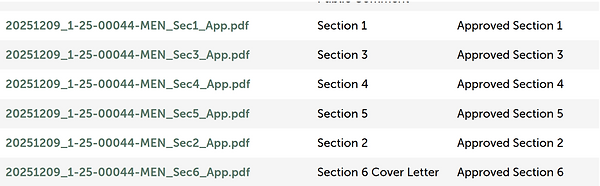
What's in Each Section of a THP?
_edited.png)
Key items to check within Section 2:
-
#14(a): Silviculture (ex: clearcut, group selection, single selection, etc.)
-
#16: Yarding methods (ex: tractor, cable, helicopter)
-
#17: Erosion Hazard Rating (how geologically unstable the area is)
-
#24: Roads and landings (Will new roads or landings be constructed? Are they temporary or permanent?)
-
#26: Watercourse and lake protections (Are adequate buffers being implemented around watercourses?)
-
#32: Wildlife (What kinds of protections are being implemented for wildlife?)
Important documents in the “Attachments”
-
CDFW and other agency comments
-
First Review Team Questions: Questions from the reviewing agencies, answered by the RPF
-
Official Response to Public Comments: You can check to make sure CAL FIRE adequately responds to your public comments
-
CDFW 1600 Agreement
-
PHI Report
Common Negative Impact Issues
-
Clearcutting
-
New Road Construction
-
Water Quality Issues (sediment from logging and roads)
-
Pesticide Use
-
Northern Spotted Owls and other endangered species
How to Write a Public Comment
-
According to the Forest Practice Rules, section 1037.4, public comment is open from the time the THP is posted to CalTrees (accepted for filing) until 10 days following Second Review
-
CAL FIRE is required to respond to written comments; responses become a part of the official file
-
-
Public comments can change the outcome of a THP, either resulting in revisions to the plan or stopping it altogether.
-
It is important to write a strong public comment that shows the project has a significant adverse environmental impact that hasn’t been mitigated by the plan.
-
Include as many facts as possible in your comment, with specific examples
-
Pictures and maps can be helpful
-
Cite agency reports or resources like maps or databases, past statements, established protocols
-
If CAL FIRE or another reviewing agency made a mistake or did not follow the law, point this out
-
-
For North Coast Region THPs, submit comments to SantaRosaPublicComment@fire.ca.gov

-
CalTrees Shepard is an AI-powered THP Viewer and Public Comment writing tool
-
It allows you to see all THPs in the state that are currently open for public comment, and helps you write and send a comment tailored to your concerns.
-
You can also look at data for the affected watershed and how the THP may impact carbon storage and sequestration and hydrologic impairment
-
Disclaimer: Please review letters for accuracy before sending, as AI may make mistakes
-
When a THP isn't Needed
-
Harvesting dead, diseased, or dying trees where less than 10 percent of the average stand volume per acre is removed.
-
Harvesting dead trees from damaged timberlands (for example, after a wildfire)
-
Harvesting to create or maintain a firebreak.
-
Harvesting to restore or conserve California black or Oregon white oak woodlands and grasslands
-
Harvesting Christmas trees

Summary of exemptions allowed by forest practice regulations. Source: Morrison, H. et al. 2007. Laws and Regulations Affecting Forests, Part I: Timber Harvesting, Forest Stewardship Series 19, Publication 8249, University of California Division of Agriculture and Natural Resources.
Emergency notices
-
Cutting or removing trees that are dead or dying as a result of insects, disease, parasites, or animal damage.
-
Cutting or removing trees that are fallen, damaged, dead, or dying as a result of wind, snow, freezing weather, fire, flood, landslide, or earthquake.
-
Cutting or removing trees that are dead or dying as a result of air or water pollution.
-
Cutting or removing trees required for emergency construction or repair of roads
Conversion Exemptions
-
One-time conversion of land use of up to 3 acres (for example, from forest to a home site).
-
Construction or maintenance of right-of-way by a public agency on its own or any other public property.
-
Clearing of trees from timberland by a private or public utility for construction of gas, water, sewer, oil, electric, or communications rights-of-way, and for maintenance and repair of the utility and right-of-way
How to Use CalTrees to Check if Operations Have Started for a Timber Harvest Plan
Go to the CalTrees website and click “Search Plans.” Enter the THP name or number (you only need one) and make sure the open date is correct. For recent THPs, doing a year from the current date works:

Click the plan number to go to the plan page. Click the drop-down menu that says “Record Info” and choose “Related Records”

Scroll down and look for a document labeled “ComOp” which means “Commence Operations.” The date listed after is the date operations have started. There is no other information or documentation included.
